What Are the Stages of a Breakup?
If you’ve Googled this, you’re probably hurting.
Most articles will tell you there are neat, predictable “stages” of a breakup: denial, anger, bargaining, depression, acceptance. It sounds clean. Organized. Almost comforting.
But in real life?
Breakups are not linear.
They are not tidy.
And they are definitely not one-size-fits-all.
As a therapist who specializes in breakups and attachment healing, I actually don’t talk about “stages” AT ALL with my clients. Because what you’re experiencing is an attachment response.
Why “Stages” Can Feel Misleading
The idea of stages originally comes from grief models like those developed by Elisabeth Kübler-Ross. While helpful in understanding loss, romantic attachment is layered with nervous system activation, childhood attachment patterns, trauma history, and relational conditioning.
So instead of asking:
“What stage am I in?”
I encourage people to ask:
How is my attachment system responding?
What feels threatened right now?
What old wound just got activated?
Why does this feel bigger than just this relationship?
Because often… it is.
Your Breakup Reaction Depends on Your Attachment Style
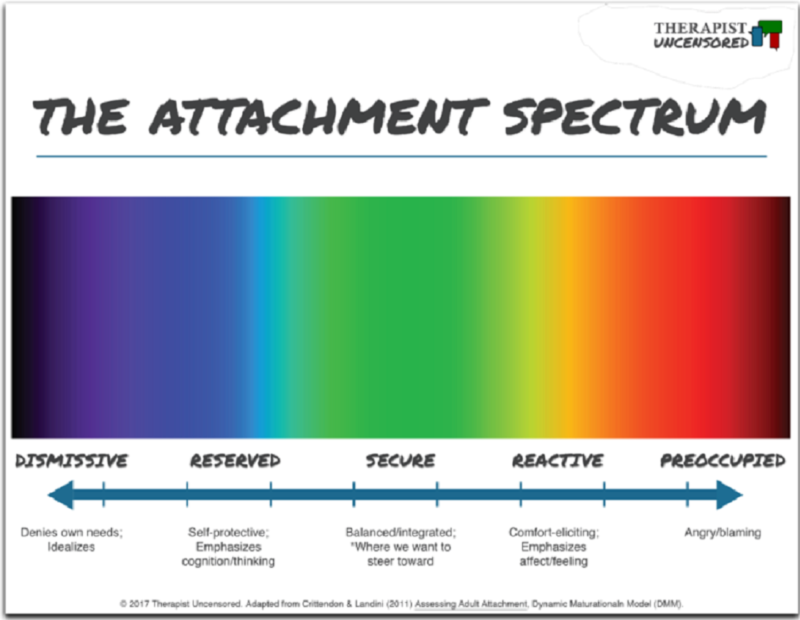
Credited to Sue Marriott and Ann Kelley- Modern Attachment Spectrum from their book Securely Relating
Not all heartbreak looks the same.
If you lean more anxious in attachment:
You may feel obsessive thoughts.
Urges to reach out.
Panic, bargaining, replaying conversations.
A deep fear of being alone or replaced.
If you lean more avoidant (what is known as “blue” on the attachment spectrum):
You might detach quickly.
Feel relief.
Move on fast.
Or suppress feelings until they show up later.
And if you’re more secure?
You’ll still hurt.
But the pain won’t destabilize your sense of self.
This is why comparing your breakup to someone else’s is dangerous.
Your friend might be “over it” in a week. That doesn’t mean you’re weak. It means your nervous system and attachment history are different.
Why Some Breakups Hurt So Much Longer
Breakups don’t just end a relationship.
They activate:
Abandonment wounds
Rejection sensitivity
Unworthiness stories
Childhood attachment trauma
Nervous system dysregulation
And here’s the part I tell my clients:
When the pain is loud… the portal is open!!!!
Heartbreak brings old wounds to the surface. The grief, anxiety, and longing are often pointing to something deeper that wants healing.
You can:
Push it down.
Date someone new to numb it.
Or obsess over your ex.
Or…
You can use this as an opportunity to actually heal the attachment patterns that keep repeating.
This Is Why Individualized Healing Matters
Instead of forcing yourself into “stage 3” or waiting for “acceptance” to magically arrive, it’s more powerful to understand:
What is my attachment style?
How does my body process loss?
What patterns do I keep repeating in relationships?
What does my nervous system need right now?
Sometimes that work is cognitive.
Sometimes it’s relational.
And sometimes it requires deeper approaches like somatic therapy or EMDR to help your body process the shock and attachment rupture.
Breakups aren’t just emotional events. They are nervous system events.
Please Don’t Compare Your Healing Timeline
If you are still hurting months later, that does not mean you’re dramatic.
It might mean:
This relationship tapped into an old wound.
You don’t have the tools yet to regulate the attachment panic.
Your system bonded deeply.
You loved hard.
And loving hard is not a flaw.
But learning how to love securely — including loving yourself — is a skill.
If You’re Struggling, Reach Out
You don’t have to navigate this alone.
Working with someone who specializes in breakups and attachment can completely change how long this pain lasts — and what you learn from it.
And if you’re not ready for therapy but want guidance?
My breakup mini-course is now live. It walks you through:
Understanding your attachment response
Calming your nervous system
Managing urges to reach out
Rebuilding your sense of self
Turning heartbreak into growth
Because this isn’t just about getting over your ex.
It’s about becoming more secure in yourself.
If you’re in the middle of heartbreak right now, I want you to hear this:
You’re not behind.
You’re not broken.
You’re activated.
And healing here doesn’t just close the chapter.
It changes your entire relationship pattern going forward.
The portal is open.
What you do with it matters. 💛