Breakup Coaching vs. Breakup Therapy: Which One Is Right for You?
The other day, I was on Instagran and a well-know dating coach was asked a question about “how to heal from a breakup”. The coach acknoweldged it was not her specialty, and then tagged 3 coaches that did specialize in this area.
This brought up some frustration, knowing my experience working with clients in the therapy setting, and knowing that yes some people might be ok with working with a coach. But others really would benefit more from working with a therapist.
So I saw this as the perfect opportunity that I think is worth talking about.
One important distinction is that coaching generally assumes that you have the capacity to set goals, take action, and follow through (with the support of the coach) even if you need some guidance and accountability along the way.
Therapy can help when something is getting in the way of that capacity.
Because when you have significant attachment wounds, trauma, anxiety, or emotional dysregulation, knowing what you should do and actually being able to do it can be two very different things.
You can know:
“I shouldn't text my ex.”
“I need to stop checking their social media.”
“I deserve better.”
“I need to move on.”
And still feel like you physically cannot make yourself do it.
That's not necessarily a motivation problem.
Sometimes there's something underneath it that needs to be understood and worked through.
So what does a breakup coach do?
A breakup coach can be a great fit if you're looking for direction, accountability, and support taking action.
Maybe you already know what you want and you're ready to make it happen.
You might want help with:
Creating and sticking to a no-contact plan
Rebuilding your confidence
Getting back into dating
Setting boundaries
Figuring out what you want in your next relationship
Creating goals for this next chapter
Staying accountable to the changes you want to make
If you're thinking, “I know what I need to do. I just need someone to help me do it,” coaching may be a great fit.
So what does breakup therapy add?
As a therapist, I can do many of those same things.
I can be direct with you.
I can hold you accountable.
We can talk about your ex, dating, boundaries, no contact, communication, and what you want your next relationship to look like.
But therapy also gives us the ability to ask a bigger question:
What's getting in the way of you being able to do what you already know you need to do?
Maybe you're extremely anxious every time someone pulls away.
Maybe you become consumed with thoughts about your ex.
Maybe you repeatedly choose emotionally unavailable partners even though you desperately want something different.
Maybe you know you should leave a relationship, but the thought of being alone feels unbearable.
Maybe you're constantly questioning whether you're enough.
Or maybe your breakup has activated old feelings of abandonment, rejection, shame, or not being chosen.
That's when I want to look at the bigger picture.
We might explore your attachment patterns, past relationships, early experiences, nervous system regulation, emotional triggers, and the beliefs you carry about yourself and relationships.
And we don't just talk about those things.
We can actually work on them.
That might include learning regulation skills, building emotional capacity, developing more secure relationship skills, working with different parts of yourself, or processing painful experiences through approaches such as EMDR.
Here's how I think about the difference:
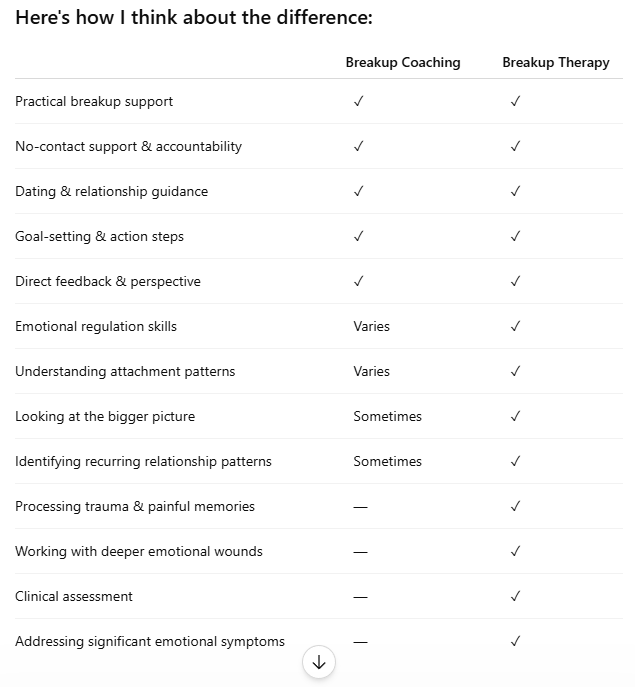
The point isn't that one is better than the other. It's about what kind of support you need.
If you're relatively regulated, have a good sense of what you want, and can set goals and follow through, coaching may be exactly what you're looking for.
But if you keep thinking, “I know what I need to do, but I can't seem to do it,” that's where I'd consider therapy.
Because sometimes the problem isn't that you need another five-step plan.
You need to build the emotional capacity to actually follow the plan.
And if your breakup has brought you to a place where you're experiencing suicidal thoughts, thoughts of self-harm, or you're worried about your ability to keep yourself safe, please seek professional mental health support. That's not a situation where I would recommend relying on coaching alone.
You deserve support that matches what you're actually experiencing.
And sometimes healing isn't just about learning what to do next.
It's about understanding why it's so hard to do it in the first place—and helping you become more capable of doing it.
That's the work I do in breakup therapy.

Hi! I’m Nicole Braswell, Licensed Therapist in California with over 13 years of clinical experience.
I specialize in working with adults wanting to improve attachment, work through trauma that is affecting their ability to have healthy, secure, and loving relationships.